Monday
15th November
2004-
Both the emotional and rational minds are astounded
by the result. The expectation of each was that after the adjustments
described earlier there would be nothing of significance in a comparison
of the Nostradamus' text with the others. Below is the chart of the
results of the analysis.
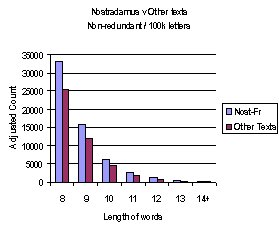
The graph displays words
of length greater than 7. The word base was filtered by me for
words below 6 as these smaller words become so easy to find that
any deliberate anagrammatisation would be hard to see. The
analysis below 8 words is therefore discarded in the presentation
of all charts.
The results show that there is a clear and consistent pattern
in all groupings that place Nostradamus' text well above the other
texts.
The right hand, emotional side of the brain is pleased but apprehensive at this
result for although it seems this is a clear victory it knows the
left-hand side too well, this result will be pursued to try and find its
logical flaw.
And the emotional side is
also disappointed for it aches for the issue to
be resolved and a negative result would have allowed this quest to end. Nothing is proven
by this result, it just continues the pattern whereby
Nostradamus text
continues to intrigue and puzzle me.
Already the computers are running once more, running logical tests to
try and resolve what it means when an analysis of a French text using
English words leads to this surprising
result.
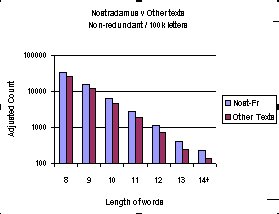
This process of understanding begins with the graph below, which uses a
logarithmic scale to display the result. This shows much more clearly that
as the length of words increases there is a distinct increase in the ratio
of Nostradamus count compared to that of the Other texts.
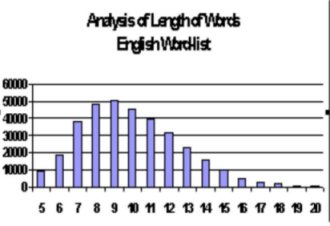
 A normal scale uses equal
intervals on the vertical axis to show the same gap in count. In
the previous graph (above) each label on the vertical scale is evenly spaced
and is 500 counts greater than the one below it. The normal graph is excellent for
small vertical ranges.
A normal scale uses equal
intervals on the vertical axis to show the same gap in count. In
the previous graph (above) each label on the vertical scale is evenly spaced
and is 500 counts greater than the one below it. The normal graph is excellent for
small vertical ranges.
A logarithmic scale shows proportions much better when the
graph covers a large range. In the graph alongside each label on
the vertical axis is evenly spaced but is 10 times greater than
the one below it.
This graph suggests that a straight line could be drawn across
the tops of each Series. Each line has a distinctive slope and
they come together at some point to the left of the graph
It would not be surprising to see such a result if there was deliberate
coding for it is less masked where randomly generated anagrams are less
frequent (i.e. longer words).
Potential for Code in the Other Texts
The reason for choosing several texts in
different languages was to try and quantify the extent of random anagram
generation. Dante in modern English was expected to be particularly
significant in this regard for it is nigh impossible for it to contain
coding.
Several of the texts were from a period in time where coding
in text was very fashionable. It has been implied that Shakespeare's work
may hide code in the forms of anagrams but the selection of sonnets makes
this selection unlikely to be coded (for the nature of the word is
paramount in sonnets). The same can be said for Moliere who was writing a play that
needed to be attuned to the ear, not the mind.
Saga's are different
for in telling a story, elegance is less important, So Dante's Italian and
Roland's Chansong hold greater potential for concealing code
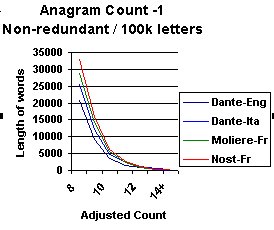 The results
for each of the different sources is shown alongside, this time using a line
rather than column graph.
The results
for each of the different sources is shown alongside, this time using a line
rather than column graph.
Nostradamus text remains above each of the other texts
throughout the range (Except at 13+ stage where Dante-Italian
exceeds Nostradamus).
Dante's English version falls into the pattern that could be
expected for an uncoded work. It has the least number of anagrams.
Shakespeares sonnets also fit to the expectation but Moliere does
not. It lies closer to the Nostradamus text than anticipated. So
is it coded or is there an error or a structural
explanation?
Roland's Chansong and Dante's Italian version show the signs
that could imply coding- they lie beneath Nostradamus but above
the one's expected not to show any signs of code.
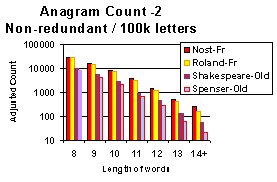
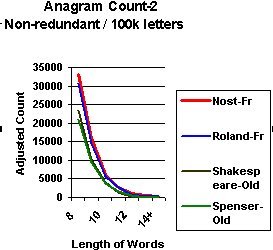 The two genuine
English sources, Shakespeare and Spenser
show a slightly greater count than the Dante version but less than
their French counterparts. This result is indeed intriguing and
could be a reflection of coding but it might indicate a flaw in
the methodology.
The two genuine
English sources, Shakespeare and Spenser
show a slightly greater count than the Dante version but less than
their French counterparts. This result is indeed intriguing and
could be a reflection of coding but it might indicate a flaw in
the methodology.
They imply a need for some simple tests.
The sources have unequal numbers of letters in them and it is important
to test whether my equalisation factor distorts the result. The nature of
the data is such that a simple test can be provided.
The sum of the Other
Source letters is very nearly equal to half the letters In Nostradamus. By
using 2 line pairings of Nostradamus' four- line-quatrains as a basis for
comparison
it can be shown the results still hold.
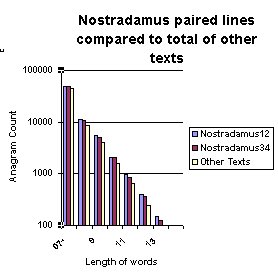 The nature of the
paired line graph alongside has additional confirmation to a trend
apparent in the earlier charts. It implies that the best chance of
determining the existence of code occurs in the analysis of longer
words found in each text.
The nature of the
paired line graph alongside has additional confirmation to a trend
apparent in the earlier charts. It implies that the best chance of
determining the existence of code occurs in the analysis of longer
words found in each text.
The evidence, although it doesn't prove there is coding, does
have a direct bearing on the search, for it indicates the things
which need to be tested.
The research at this point sheds little light on whether this
coding was in English and certainly it tells us nothing about the
purpose of any code that might be contained in any text. These are
aspects that can perhaps be resolved once some of the issues
regarding this part of the search are more fully answered.
Amongst the
significant questions that are raised by
these results is the reason why
the texts written in foreign
languages show a tendency to imply code when examined with an
English word base. Even if they are in code it would seem unlikely
they are coded in their own language. Simple logic suggests that
testing
with an English base should not reveal a coding pattern in another
language. However simple logic often leads to wrong conclusions (as in the
case of "Which one of
a lead, wooden and glass ball of same
size will fall fastest when dropped?-They all fall at the same rate).
The simple logic suggesting English (or another foreign base) would not
work is undermined by the connections of profiles in different languages.
In this series of analyses I am not actually looking for
English words in other language texts, I am looking for anagrams
of English words.
In preparing for this analysis I have drawn upon the Moby reference source to construct both a French
and an Italian word base. I have then examined them using my anagram
profile functions and MS Access query tools. These foreign word bases are not as big as the English word base but
they show that between 16% and 20% of the anagram profiles in the smaller
bases are common to each other and the English word base.
| 1stSource |
No. of Unique profiles in list 1 |
2nd Source |
No. of Unique profiles in list 2 |
Common profiles |
| English |
310,000 |
French |
120,000 |
24,955 (20%) |
| French |
120,000 |
Italian |
52,000 |
8002 of (16%) |
| Italian |
52,000 |
English |
310,000 |
9251 (18%) |
This is a high percentage and if to this is added the very significant
number that have very-similar profile then we will always get a large
number of anagrams no matter what language is used,. However, the expectation would be that the variance
between those with and without coding should increase when analysed with the
appropriate language base (that in which the code is written).
It is evident from this that I should at least run a full test using the
French Word base to see if the results hold and to see what is revealed.
This research has shown that a huge number of anagrams of varying
lengths occur by chance. (The number of occurrences is certainly much larger than
I expected.)
I consequently believe that the finding of anagrammatic structures in
any text is extremely likely and that the ability to find chance sequences
that suggest a meaningful relationship are also high.
From this we can conclude that:
- the finding of a
pattern in a very small and restricted set can't and shouldn't imply it
was deliberately implanted.
- the superabundance of anagrams to be found in all texts means it cannot be argued that chance alone supports
the import of any single message.
- it renders
meaningless those anagrams formed by letter substitutions- such practices
are no more than
a license to fantasise.
- Gematria and Temurah methods of reading texts would appear to have the
same order of credibility as tea-leaf reading.
Yet we know code does exist in many texts and in order to assess it
we need a more rigid understanding of what is abnormal and what can occur
by chance.
In order to go beyond this issue of probability and create a firmer
base, an understanding of the
findings in the earliest part of the research are essential.
In order to pursue this I have created two different functions to randomise the order in
the search lines. This means they contain the same letters but the
syllabic structures are destroyed. This has then been used to analyse 1 in
every 9 of the search lines in each Word base. Exact correlations
can therefore be created for each line that is examined
in its
original and randomised state.
Tuesday 16th November
2004- The French analyses
are complete and I have the
computers running once more. They are testing randomisation when the word
base is in English.
Since there are a different number of words in the English and French
data bases it needs to be highlighted that my comparison for different
languages is of form
rather than quantity. It is difficult to know at this stage what impact
trebling the word base has, it is highly unlikely to produce 3 times as
many anagrams (per 100k letters) and
is unlikely to have a definable
factor. However in the two bases I have used this factor for non-redunadant
anagrams seems to be
between 1.40 (unique word-forms only) and 1.55 (non-unique forms included-
e.g repetitions such as
rat, art, tar).
The English word base I have used is so large because it includes a vast
number of technical names and terms from a range of sciences and human
endeavours. These are not part of the French word-base although many (such
as chemical names) would be identical in each.
The reason for running the French word base is that a pattern seems
to have emerged from the English analysis - it shows a distinct
difference in the sources that is consistent over the full range of
word-lengths.
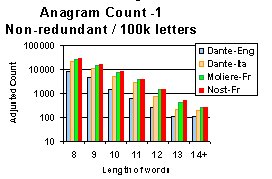
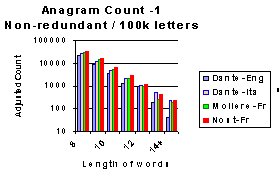
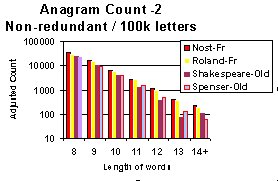
The graphs below comparing the new French analysis to the earlier
English one use a slightly different format to that used earlier- (logarithmic
columns where each interval is ten times the one below it). They are
divided into two groups (Count 1 and Count 2) and the results for the
English and French word bases are shown alongside each other.
Significantly, when looking at the new results using a French
lexicon base, there is no change
in the order of the sources and there is no change in the consistency of
the result over the range of word-lengths.
One reason for running the program using the French data was to test
whether the low result for the English sources was due to something
inbuilt into my program that prejudiced the result against the host
language. These graphs show that this is not the case- the English sources
are still poorly performed while all the French sources are very highly
performed. Dante's English version performs
worst
in both
languages. This English version of Dante was tested as a form of control (highly
improbable that it is in code) and its placement provides no reason to
dismiss the theory that these anagrams are revealing the potential for
hidden code. And
Shakespeare's Sonnets support this view- they give a better comparative
performance under English analysis than in French. We can therefore
conclude that on the sample tested my methodology produces consistent
outcomes across various languages.
There are still important issues to be resolved because at this point
we have observed a difference but not offered any reason as
to why the English and French sources differ in
the counts found in both word bases. However English is built on a
historical basis and offers many more alternative word forms than French.
These alternatives are derived from a whole host of invader-based sources
and therefore English is likely to perform well across many
languages.
In the next section of this paper I look at the classes of words in
Nostradamus text in order to discover whether there are imbalances or
themes that support the idea of coding. In the rst of this paper I look at
the impact of randomising letters for those more interested in coding
methodology.
Sunday
21st November
2004- I have spent the last few days trying to understand
and then present the results of my random-letter analyses.
My hope was to produce a formula for the measurement of coding in any
text. Although I cannot provide a totally definitive measure I believe the
following provides a fair comparison basis Adjusted Anagram Count= Anagram
Count x Word-Base-Size-Factor (1.55 for French, 1.0 for English).
I believe that it is essential in any measurement for any data to be
assessed in the following ways.
- Analysis using a word base in the same language as to that in which
the text is written.
- Analysis of the text using a different language word base
- Analysis of a text known not to be coded.
- At least one analysis of the randomised lettering of the lines of
text.
The first two allow a measure to be made of the randomised and
non-randomised generation of anagrams.
My results from randomising lettering.
The purpose of my randomised lettering test was to establish a base
level for anagrams generated from a randomly ordered lettering set.
The first method I applied was to randomise the order of the lettering
in the line based on a random number generator. This caused a marked drop
in the count for every source. However, I realized this form of generator
might well preserve syllabic structures (just as random shuffling of cards
can preserve flushes etc.). In order to break these down I used a second
method.
The second method involved dividing the letters into four (1,5,9 etc,
2,6,10 and so on) then placing these groups one after the other. The
result of this was a further significant fall in the number of anagrams.
This analysis has an immediate import on the relevance of Nostradamus
text. The text I have used for the analysis is derived from Erika
Cheetham's "The Final Prophecies of Notradamus" -Warner Books
-1993. In her preface she says "Note to Reader: The French text of
the quatrains reproduces as closely as possible that of the original
edition of 1568 (Benoist Rigaud, Lyon).."
Now this text is most
peculiar, replacing u's with v's and v's with u's and using words and
using many spellings no one has been able to attribute to normal patterns.
e.g. The fourth line says "Fait psperer q n'est a croire vain."
It would be expected that on the basis of this oddity throughout the text
that Nostradamus
text should be below the other texts, not above them, when
any anagram count is taken. I can conclude on the basis of the
randomisation effect that the high count for Nostradamus' text is likely to be
understated.
There is also a significant pattern to be found when
looking at the results for same language Text and Word-base versus ones
that are different. This is much easier to interpret after a fair
allowance is made for the difference in Word-base size (I applied a factor
of 1.55). A
consistent fall applies when analysed
with a word-base in a language different from the source. This fall
persists even when the line of text is randomised. The result using my two
methods of randomisation lead to similar values and imply that there is a
1 in 6 decrease in count level whenever measuring English and French. This
is independent of the direction (i.e Enlish Text to French base, French
text to English word base). This has to be due to structural constraints
between the two languages and in particular in the frequencies of letter
usage.
Count of words
with more than 6 letters -Non-Redundant anagrams/100k letters
Text
in original order
|
Source |
Wordbase
Same-Lang |
Wordbase
Diff-Lang |
adjusted
Same-Lang |
adjusted
Diff-Lang |
ratio
S/D |
|
French
Sources |
93413 |
113388 |
144790 |
113388 |
1.28 |
|
Nost-Fr |
98188 |
123724 |
152191 |
123724 |
1.23 |
|
English
Sources |
79842 |
32155 |
79842 |
49840 |
1.60 |
Text randomised by 4
way split
|
Source |
Wordbase
Same-Lang |
Wordbase
Diff-Lang |
adjusted
Same-Lang |
adjusted
Diff-Lang |
ratio
S/D |
|
French
Sources |
42960 |
57246 |
66588 |
57246 |
1.16 |
|
Nost-Fr |
44451 |
61547 |
68899 |
61547 |
1.12 |
|
English
Sources |
42873 |
24135 |
42873 |
37409 |
1.15 |
Although there is a smaller difference in this ratio for the
Nostradamus' data it isn't enough to conclude that Nostradamus' text is
coded in any language other than French (if at all).
However, this
fall in count for language also implies that the count for Nostradamus'
text is understated. His text is known to include Provencal, Latin and a
variety of
language variations. At best there impact should be
neutral but in all probability they would mean the count given is
understated.
There is a distinct difference in the results for the
English sources and the French sources. Part of this arises because the
English base is less English than might be expected. It incorporates many
French words that are used in English. There are 13, 870 words that are
common to the French and English data bases.
When these words are
removed and each data base is showing its true language characteristics
there is still a bias against anagrams in the English sources. A
significant shift is however seen in the ratio's of same to different
anagram counts. Nostradamus' text falls further behind implying that it is
less pure in its use of the French Language.
|
Source |
Wordbase
Same-Lang |
Wordbase
Diff-Lang |
adjusted
Same-Lang |
adjusted
Diff-Lang |
ratio
S/D |
|
French
Sources |
78244 |
93666 |
125190 |
93666 |
1.33 |
|
Nost-Fr |
86165 |
109413 |
137864 |
109413 |
1.26 |
|
English
Sources |
79590 |
32611 |
79590 |
52178 |
1.52 |
The difference between the English and French counts may still include
a structural component but even so the results show that once more
Nostradamus' text is different to the other French texts. Once more
through its high anagram counts it consistently points to the possibility
of anagrammatic code.
At this point I would conclude that contrary to
expectations Nostradamus' text has withstood my analysis. It consistently
outperforms the other texts, across all
categories. Further the nature of
the text implies that this result is made more relevant because there are
valid reasons for believing the count to be understated.
These
conclusions imply that the analysis should be taken a stage further with
there still being a possibility that Nostradamus' text is not in French
and may be multilingual.
In this
part of the analysis I have looked solely at the statistical nature of the
anagrams, devoid of any relevance. The next step is to analyse the words
that have been uncovered and see if they hold some measurable
significance. The next stages will perform the following:
- Analyse the longer words into categories
- Determine whether the count for these categories deviate from
those within the word-base.
- Analyse whether there is any association between words in
specific locations.
|
NEXT STAGE OF ANALYSIS
Click here |